
Have you ever looked at a car and wondered why its tint looks darker while others appear crystal clear? The secret lies in one important factor: Visible Light Transmission (VLT). Whether you want to keep your car cool, enjoy privacy, or ensure safe visibility, all of these factors depend on how much light passes through your car’s windows.
To understand what visible transmission is, read through this guide that simplifies every small detail, from understanding VLT in window films to choosing the ideal VLT for car windows that balances comfort, style, and legality.
What Does Visible Light Transmission (VLT) Mean?
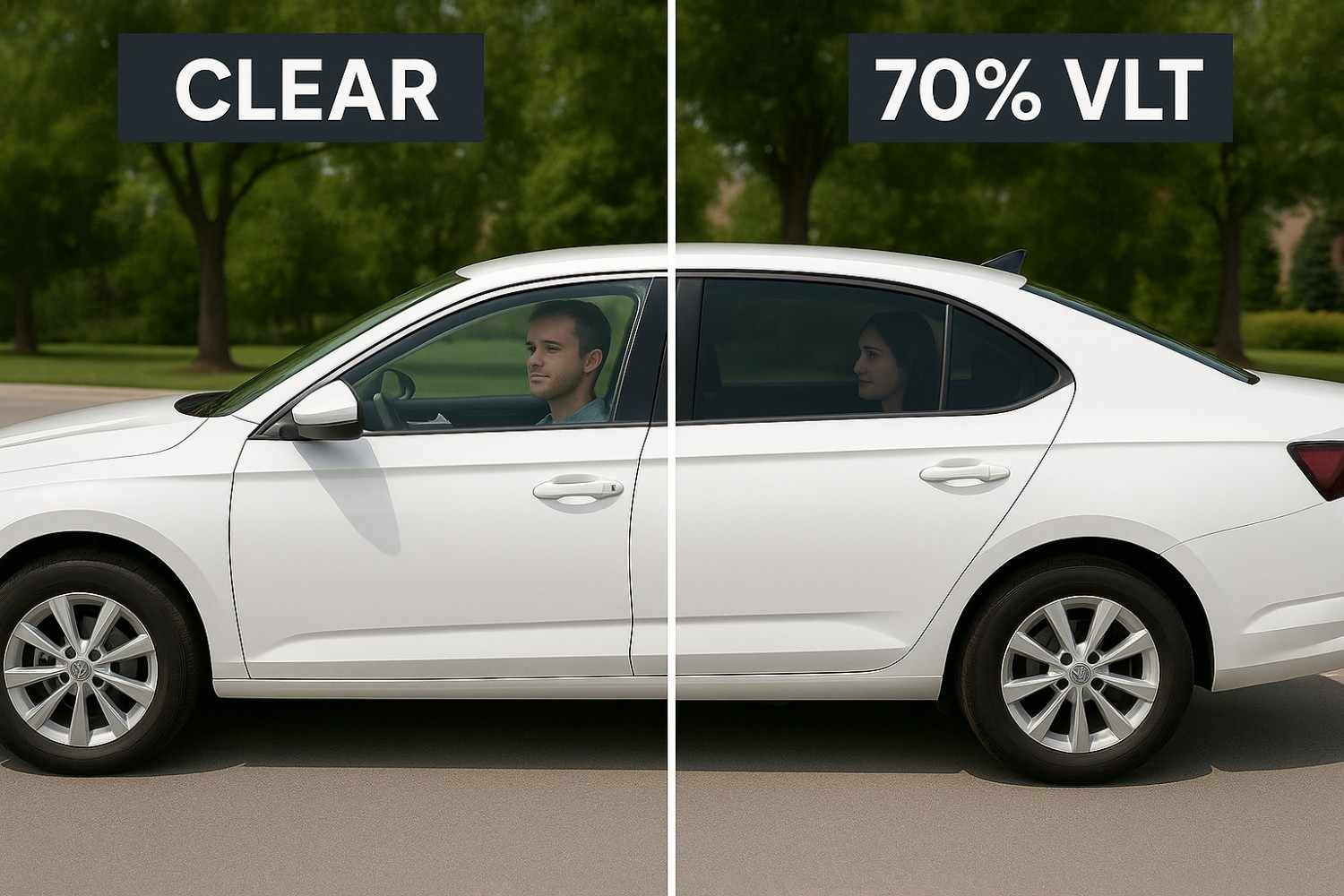
Visible Light Transmission (VLT) refers to the percentage of visible light that passes through your car’s glass and tint film. The higher the percentage, the lighter and clearer your tint appears.
Example: If a 70% VLT film allows 70% of visible light to pass through, it appears almost transparent. In contrast, a 20% VLT tint allows only 20% of light, giving a darker, more shaded look.
Therefore, visible light transmission (VLT) is important for understanding how your tint affects visibility and comfort.
How to measure visible light transmission?
VLT measurement can be carried out by using a tint meter that determines how much visible light passes through both the glass and film combined. The calculation follows a simple formula:
Final VLT = (Glass VLT × Film VLT) ÷ 100
Why is VLT Important for Cars?
Selecting the appropriate VLT window tint should be both practical and visually appealing, as it greatly affects your comfort, privacy, and safety. They are important because:
-
An appropriate VLT percentage film will cut down on glare from the sun and headlights, making driving a strain-free experience.
-
Tints with high VLTs block infrared heat to keep interiors cooler and ease the burden on your car’s AC. In India, this is a great advantage, particularly given its hot climate.
-
A medium VLT window tint provides privacy while retaining a view of the road, to help keep you safe behind the wheel, day or night.
-
While VLT focuses on light transmission, most premium films also block up to 99% of harmful UV rays, protecting your interiors and skin from damage.
That’s your VLT value explained: it’s not just about how your car looks, but how it feels on every journey.
VLT Percentages Explained (With Examples & Chart)
Here’s a simple Window Tint VLT Guide to help you understand how various VLT percentages perform:
| VLT Range | Visibility Level | Common Use |
|---|---|---|
|
70% and above |
Nearly clear |
Front windshield |
|
50–70% |
Balanced visibility |
Side & rear windows |
|
30–50% |
Medium tint |
Privacy & glare reduction |
|
5–20% |
Dark tint |
Maximum privacy, limited visibility |
When comparing high VLT vs low VLT, remember that higher VLT means more light and clarity, while lower VLT gives deeper shading and enhanced privacy. Choose your visible light transmission in window films carefully, as it affects both aesthetics and compliance.
VLT for Cars vs Homes -
The purpose of Visible Light Transmission in window films varies between automotive and residential use. For cars, it focuses on road visibility, comfort, and legal compliance. On the other hand, for homes, it focuses on glare reduction, UV protection, and energy savings. This is the difference between VLT for cars vs homes; one prioritises driving clarity, the other, comfort and efficiency indoors.
Legal VLT Limit in India
According to the Central Motor Vehicle Rules (CMVR), India has clear guidelines for visible light transmission in glass:
-
Front Windshield: Minimum 70% VLT
-
Side Windows: Minimum 50% VLT
-
Rear Windshield: 70% (if equipped with a rearview mirror)
These limits ensure safe driving visibility while maintaining comfort. However, always check your local RTO for any regional variations in the legal VLT limit in India before installation.
How to Choose the Ideal VLT for Car Windows
The ideal VLT for car windows depends on your region, comfort preferences, and compliance needs. Consider:
-
Comfort vs Privacy: Strike a balance between visibility and seclusion.
-
Legal Compliance: Always stay within CMVR-approved VLT levels.
-
Aesthetic Appeal: Lighter tones look subtle and elegant, while darker shades create a bolder statement.
Benefits of VLT Window Films
Opting for the right Visible Light Transmission (VLT) film brings multiple advantages:
-
Keeps your cabin cooler and more comfortable.
-
Reduces glare and eye fatigue.
-
Protects interiors from UV damage.
-
Enhances privacy and overall appearance.
-
Ensures safety as a fundamental priority.
That’s the beauty of understanding the benefits of VLT window films: clarity, comfort, and compliance in one sleek layer.
Professional Installation & Consultation
Accurate VLT measurements and correct installation are important to get the desired performance of the film. VLT percentage may even be compromised due to a small installation error, which results in uneven tinting or a legal issue.
That’s why it’s important to trust in trained experts, as they use professional-grade tools that ensure smooth finishes and long-lasting durability.
When precision and compliance are required, look for Garware Hi-Tech Films, whose films adhere to CMVR requirements and are carefully crafted for optimum visible light transmission, offering superb clarity as well as control of heat with a truly reliable performance across all vehicle categories.
Conclusion
Visible Light Transmission (VLT) is more than just a technical specification; it’s what determines how your car feels, looks, and performs on the road. Understanding VLT helps you strike the right balance between clarity, comfort, privacy, and compliance, ensuring your drive remains safe and stylish.
When selecting window films, prioritise quality and adhere to legal standards. With advanced films from Garware Hi-Tech, you get precision-engineered visibility and dependable performance that truly redefine how light interacts with your car’s interiors.
FAQs: Visible Light Transmission (VLT) in Window Films
- What is visible light transmission in window films?
It’s the percentage of visible light that passes through both the glass and the tint layer combined.
- What is VLT in window films?
VLT defines how much visible light enters through your windows. Higher VLT is clearer, lower VLT is darker.
- How to measure visible light transmission?
A tint meter calculates the visible light transmission percentage accurately through the film and glass.
- What does a 70% VLT tint mean?
It allows 70% of light through, appearing clear and legally suitable for windshields.
- Is lower VLT darker or lighter?
Lower VLT means a darker tint; higher VLT means a lighter appearance.
- What is the legal VLT limit in India?
As per IS 2553, it is Front windshield & Rear windshield: 70% VLT and all side window glasses: 50%. VLT
- Does higher VLT mean more heat passes through?
Not always. Advanced films can maintain high VLT while still blocking infrared heat.
- What’s the difference between VLT and UV rejection?
VLT measures visible light. On the other hand, UV rejection measures protection against ultraviolet rays.