
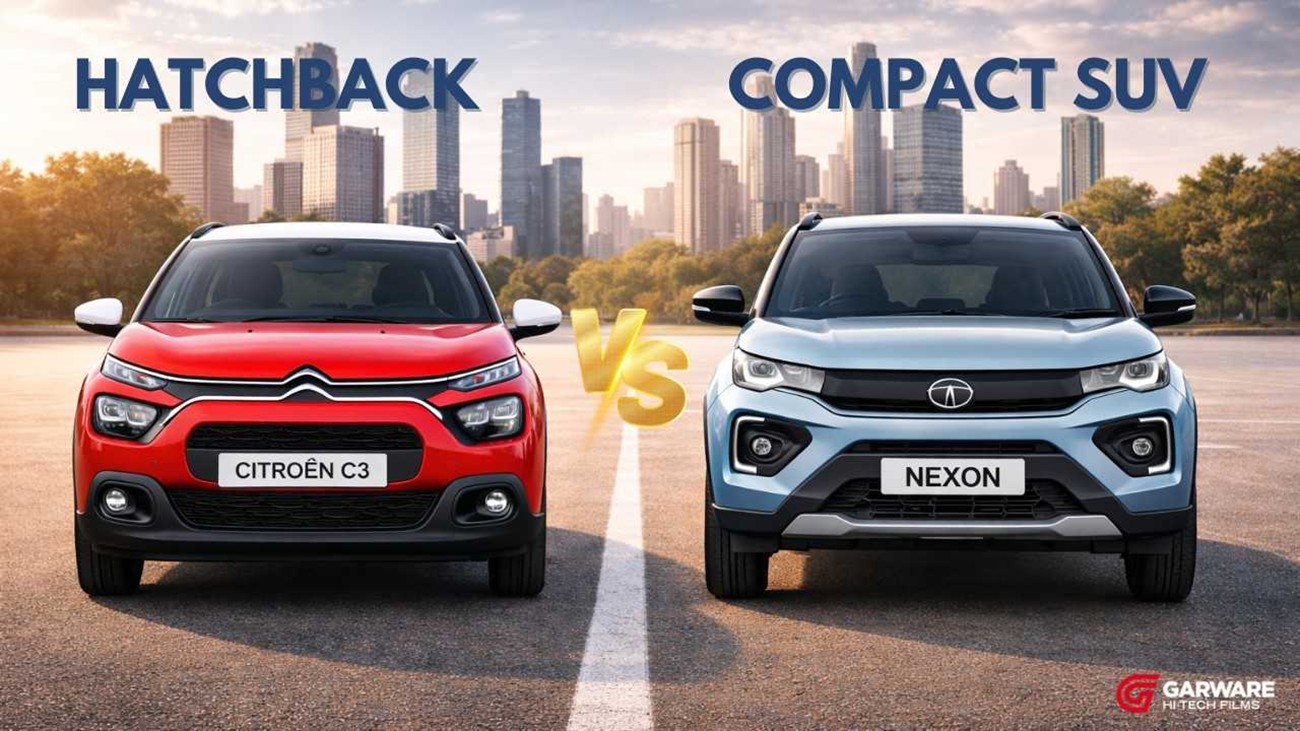
The Indian car market has changed rapidly over the last decade. Buyers who once preferred hatchbacks are now seriously considering compact SUVs, even for the same budget. With rising fuel prices, crowded cities, rough roads and feature-heavy cars, the decision is no longer as straightforward; one has to choose between a hatchback vs compact SUV.
Hatchbacks, on one hand, promise better mileage, low ownership costs, and easy city driving. Compact SUVs have higher seating, a strong road presence, and better comfort on bad roads. In this guide, we will do a detailed hatchback vs SUV comparison in India’s market, clearly focusing on real-world mileage, ride comfort, ownership costs and value for money, so that you can choose the vehicle that truly fits your usage.
What Is a Hatchback? Meaning, Features & Usage
Let’s begin by understanding both types of cars. A hatchback is a compact car with a two-box design; it has the engine in the front, and a combined passenger + boot area at the rear with a tailgate-style opening.

Typical Usage of Hatchbacks
-
Daily city commuting
-
Short highway trips
-
Budget-conscious ownership
-
Ideal for congested urban roads.
Who Should Buy a Hatchback?
-
First-time car buyers
-
Office commuters
-
Small nuclear families
-
Buyers prioritising mileage and low running costs.
Hatchbacks are known for simplicity, affordability and ease of ownership, which is why they are the highest-selling car segment in India.
What Is a Compact SUV? Meaning & Key Features
Compact SUVs fall under the sub-4-metre category, designed specifically for Indian tax benefits, while offering an SUV-like stance.

Key Characteristics of Compact SUVs
-
Higher ground clearance.
-
Upright seating position.
-
Muscular styling and road presence.
-
Often based on hatchback platforms but with upgrades.
Why Compact SUVs Are Trending
Compact SUVs are considered to be one of the best car types for Indian roads because of:
-
Better visibility in traffic.
-
Improved comfort on broken roads
-
Perceived safety and status
-
Feature-rich interiors.
These types of cars bridge the gap between hatchbacks and full-size SUVs, making them extremely popular among urban and semi-urban buyers.
Hatchback vs Compact SUV: Key Differences Explained
Here is a quick Hatchback vs SUV comparison in India:
|
Parameter |
Hatchback |
Compact SUV |
|
Price Range |
Lower |
Higher |
|
Mileage |
Better |
Slightly lower |
|
Seating comfort |
Lower seating |
Higher, more upright |
|
Ground clearance |
Limited |
Better for bad roads |
|
City driving |
Easier and stress-free |
Manageable, slightly larger. |
|
Highway comfort |
Adequate |
More comfortable |
|
Maintenance cost |
Lower |
Slightly higher |
|
Resale value |
Decent |
Generally better |
So, Hatchbacks focus on efficiency and affordability, while compact SUVs’ priority are comfort, ground clearance and presence, often at a higher cost.
Hatchback vs Compact SUV Mileage Comparison (Real-World)
Let’s compare the Hatchback vs Compact SUV mileage.
Why Hatchbacks Offer Better Mileage Than Compact SUVs
Hatchback cars are known to give drivers better mileage than Compact SUVs. This is because of their:
-
Lighter body weight.
-
Lower ride height and better aerodynamics.
-
Smaller wheels and tyres
-
Less drivetrain stress.
If you look at real-world conditions, hatchbacks return 1 to 4 km/l more than Compact SUVs which have similar engines.
Real-World vs Claimed Mileage in Indian Driving Conditions
-
Claimed mileage is tested under ideal conditions
-
City traffic, AC usage, and load reduce actual figures.
-
Compact SUVs also suffer more in stop-and-go traffic due to weight.
Mileage Impact in City Traffic: Hatchback vs Compact SUV
In dense urban traffic, hatchbacks are easier to keep efficient, while compact SUVs, especially the petrol variants, often consume more fuel.
Hatchback vs Compact SUV: Comfort & Ride Quality Compared
Here is a quick comparison of the Compact SUV vs Hatchback, comfort wise.
Seating Position: Hatchback vs Compact SUV
-
Hatchbacks: Lower seating, with a car-like feel.
-
Compact SUVs: Upright seating that offers better road view.
Suspension Setup Comparison: Hatchback vs Compact SUV
-
Hatchbacks: Softer for smooth city roads.
-
Compact SUVs: Tuned to absorb potholes and speed breakers.
Cabin Space & Headroom: Hatchback vs Compact SUV
Compact SUVs usually offer:
-
Better headroom
-
Wider cabins
-
More comfortable rear seating
Long-Distance Driving Comfort Compared
For long highway journeys, compact SUVs generally feel less tiring, especially for passengers.
Hatchback vs Compact SUV on Indian Roads
When it comes to the roads in India, which is better: Hatchback or Compact SUV? Let’s look at the different conditions and how it would suit both vehicles:
Performance on Potholes, Speed Breakers & Monsoons
-
Hatchbacks need cautious driving on bad roads.
-
Compact SUVs handle waterlogging and rough patches more confidently
Ground Clearance Advantage in Compact SUVs
Higher clearance reduces:
-
Underbody hits
-
Scraping on speed breakers.
-
Stress during monsoons.
City Manoeuvrability: Hatchback vs Compact SUV
In this case, Hatchbacks are the winners:
-
Smaller turning radius
-
Easier parking
-
Less fatigue in traffic.
Hatchback vs Compact SUV: Cost of Ownership & Maintenance
When you do a Hatchback vs SUV price comparison, you will find a significant difference in their maintenance and ownership costs.
Service & Spare Parts Cost Comparison
-
Hatchbacks: Cheaper parts, simpler repairs.
-
Compact SUVs: Slightly higher service bills.
Insurance Cost: Hatchback vs Compact SUV
Compact SUVs attract higher insurance premiums due higher vehicle value.
Tyres, Wheels & Consumables Cost
-
Larger tyres mean higher replacement costs
-
Alloy wheels add to expenses
Long-Term Reliability & Ownership Costs
Both segments are reliable if serviced properly, but hatchbacks remain cheaper to own over 5 to 7 years.
Hatchback vs Compact SUV: Safety Comparison in India
Both Hatchbacks and Compact SUVs are considered best car types for Indian roads, due to the following factors:
Structural Differences: Hatchback vs Compact SUV
Compact SUVs often feel more solid due to size and stance, but platform and build quality matter more than the segment.
Safety Features Comparison
Compact SUVs offer more safety features than Hatchbacks:
-
More airbags
-
Electronic stability control
-
Hill assist (in some models)
NCAP Crash Test Ratings: What Matters More
Crash test ratings are criticals, so choose your vehicle based on rating and not body style.
Urban vs Highway Safety: Which Is Better?
-
Hatchbacks are adequate for city use.
-
Compact SUVs, on the other hand, offer better highway confidence due to stability and visibility.
Hatchback vs Compact SUV: Which Offers Better Value for Money?
So when it comes to a Hatchback vs SUV price comparison, what are you actually paying for?
-
Hatchbacks: Efficiency, ease and affordability.
-
Compact SUVs: Comfort, features, images.
Feature-to-Price Comparison: Hatchback vs Compact SUV
Many compact SUVs justify their price with features like:
-
Touchscreens
-
Connected tech
-
Better interiors
Perceived Value vs Real-World Value
Not all benefits of an SUV translate to daily usage. The value also depends on how and where you drive.
Hatchback vs Compact SUV: Who Should Buy Which?
Choose a Hatchback if you are:
-
A daily city commuter
-
A first-time car buyer
-
Budget-focused
-
Prioritising mileage and low running costs.
Go for a Compact SUV if you are:
-
Seeking a small family car.
-
A frequent highway traveller
-
Driving on poor roads
-
Seeking comfort and road presence.
Protecting Your Car’s Value for Long-Term Ownership
Paint Protection in City Driving Conditions
Indian traffic causes minor scratches, door dings and paint fading, which can lead to the car looking old and ill-maintained. Protective measures like Paint Protection Films (PPFs), especially from brands like Garware Hi-Tech Films, help maintain the car’s appearance and preserve its resale value.
How Scratches Impact Car Resale Value
Cosmetic damage may not affect driving, but it significantly can lower the car’s resale price.
Windshield Clarity, Visibility & Driving Safety
Clear glass improves:
-
Night driving safety
-
Monsoon visibility
-
Overall driving confidence.
Final Verdict: Hatchback vs Compact SUV
Hatchbacks offer better mileage, lower ownership cost and stress-free city driving, which makes them ideal for urban users and first-buyers. Compact SUVs, on the other hand, are known to give better comfort, ground clearance and road presence, which is suited for mixed city-highway use and rough road conditions.
Making the right choice between a hatchback vs compact SUV depends on your driving pattern, budget, road conditions, and long-term ownership goals. Both vehicle segments offer excellent value, especially when chosen for the right reasons.
FAQs: Hatchback vs Compact SUV
-
Which gives better mileage: hatchback or compact SUV?
Hatchbacks generally offer better real-world fuel efficiency. -
Are compact SUVs harder to drive in the city?
They’re slightly larger, but still manageable, hatchbacks are easier to drive in the city. -
Is maintenance higher for compact SUVs?
Yes, marginally. This is mainly due to tyres, insurance and parts. -
Which is safer on highways?
It depends on build quality, and safety rating, not just the vehicle segment. -
Do compact SUVs have better resale value?
Usually yes. This is mainly due to the higher demand and appeal that SUVs have. -
Is ground clearance important in India?
It is very important, especially for bad roads and during monsoons. -
Are hatchbacks good for long drives?
Yes, they are, but compact SUVs are more comfortable for extended trips. -
Which is better for first-time buyers?
Hatchbacks. They are simpler and more affordable when compared to Compact SUVs. -
Is a compact SUV worth the extra cost?
Yes. If you value comfort, visibility and road conditions, then a compact SUV is worth the cost. -
Which car type suits Indian traffic better?
Choose a hatchback if you are in dense cities. Compact SUVs are best suited for mixed usage.